4.9/5
4.9/5








SAMPLES OF QUALITY
Recent Hand-Painted Reproductions
Discover some of our latest oil paintings, each one carefully hand-painted on canvas.

AS SEEN IN





Handmade Oil Painting on Canvas Art Reproduction, Museum-quality

The six dominant colors measured from the painting, with the share of canvas each one covers. Click a swatch to copy its hex code.
Processing & Shipping Time
Your delivery time includes two parts:
Shipping Methods
We ship with trusted couriers like FedEx, UPS, and DHL. Every shipment includes a tracking code.
Our goal is to deliver your order safely and quickly.
Shipment Safety Measures
We handle your products with care so they arrive in perfect condition:
Every product is insured and delivered right to your door, so you can feel confident buying from us.
Every Art & See painting is created by artists with 15+ years of experience using professional-grade oil paints and premium linen canvas with UV-resistant protective coating, the same museum-grade materials used in galleries worldwide. Each piece goes through quality review before your approval photos are taken. If after delivery you have any concerns about your painting, contact us at [email protected] and our team will work with you on the best path forward.
Full Warranty
Every painting is protected against physical damage during shipping. If your painting arrives damaged, we repair or replace it, free of charge.
Coverage Details
Transit damage (crushed, torn, water damage): we repair or replace at no cost. Please note that damages resulting from accidents or inappropriate use are not covered under this warranty.
Repair or Replace
Depending on the extent of damage, the affected painting will either be repaired or replaced at no additional cost to you.
Free Service
All warranty services are provided absolutely free of charge.
We want you to absolutely love your handmade artwork. Here's how it works:
In the rare case you approve the photos and the artwork has been shipped and delivered to you, and you still want additional modification requests, we can handle it as a courtesy at our discretion. If accepted, you cover the return shipping cost.
| Type | Hand-Painted Oil Painting Reproduction |
| Original Artist | Diego Velazquez |
| Price Range | $350 to $1,150 |
| Shipping | Free Worldwide |
| Returns | 90-Day Returns |
| Medium | Oil on Canvas |
| Canvas | Museum-Grade Linen Canvas |
| Technique | Hand-painted brushstroke-by-brushstroke |
| Art Style | Baroque |
| Period | 17th Century |
| Artist Nationality | Spanish |
| Orientation | Vertical |
| Subject | Portraits, Portraits female, Portraits male |
| Available Sizes | 7 (16'' W × 19'' H to 54'' W × 64'' H, including the original size), plus custom sizes |
| Framing Options | Unframed, Stretched Canvas, Classic & Modern Frames |
| Delivery | 14–28 business days |
| Size | 56 × 66 cm (22 × 26 in) |
| Year | 1657 |
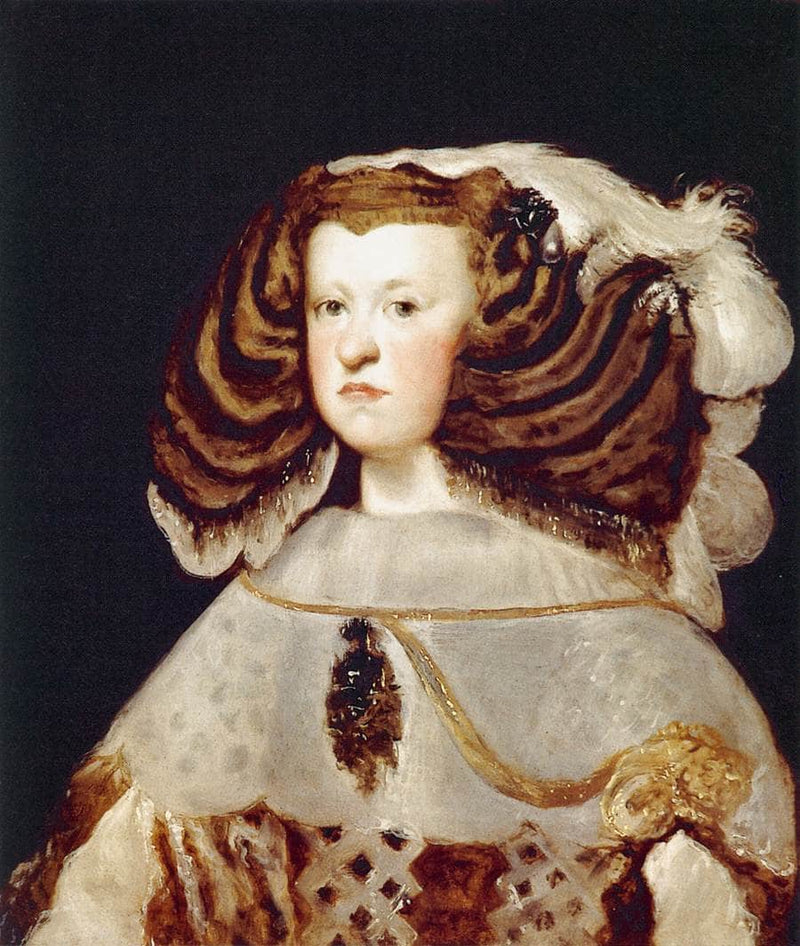
Mariana of Austria, born in 1634, was a significant figure in the Spanish monarchy. As the daughter of Holy Roman Emperor Ferdinand III, she married King Philip IV of Spain in 1649. This union was not just a romantic alliance; it was a strategic move to strengthen ties between Spain and the Habsburg dynasty. Mariana's role extended beyond mere royalty; she became a mother to several children, including the future King Charles II, whose reign would be marked by challenges.
Diego Velazquez, born in 1599, served as the leading court painter for King Philip IV. His unique ability to capture the essence of his subjects made him a pivotal figure in Baroque art. Velazquez's portraits, including that of Mariana, reflect not only the physical likeness but also the psychological depth of his subjects. His work was instrumental in elevating the status of portraiture in the 17th century.
The Baroque period in Spain was characterized by dramatic expressions and rich detail. Artists like Velazquez embraced realism, using innovative techniques to create lifelike representations. This era saw a shift from the idealized forms of the Renaissance to a more naturalistic approach, which Velazquez mastered. His portraits often conveyed the complexities of human emotion, setting a new standard in the art world.
Velazquez's mastery of oil painting is evident in the Portrait of Mariana of Austria. He employed a technique known as "alla prima," allowing him to work quickly and capture the spontaneity of his subjects. His brushwork is fluid and dynamic, creating a sense of movement and life within the canvas. This approach not only showcases his skill but also enhances the emotional impact of the portrait.
Chiaroscuro, the contrast of light and shadow, plays a crucial role in Velazquez's work. In Mariana's portrait, the soft illumination highlights her features, creating a three-dimensional effect. This technique adds depth and drama, drawing the viewer's eye to her serene expression and regal presence. Velazquez's understanding of light transforms the painting into a captivating visual experience.
The color palette in the Portrait of Mariana of Austria is rich and symbolic. Velazquez used deep reds and golds to signify royalty and power, while softer hues convey grace and femininity. The interplay of colors evokes a sense of warmth and intimacy, inviting viewers to connect with Mariana on a personal level. Each color choice reflects her status and the emotional undertones of her life.
Mariana's attire in the portrait is laden with symbolism. The luxurious fabrics and intricate details of her gown signify her royal status. The use of lace and embroidery not only showcases the craftsmanship of the time but also represents the wealth and power of the Spanish monarchy. Her attire serves as a visual narrative of her identity as queen and her role in the court.
Mariana's facial expression is one of calm authority, reflecting her strength as a queen. Her posture, upright and poised, conveys confidence and grace. Velazquez captures the duality of her character—both a powerful monarch and a compassionate mother. This balance is a testament to her influence in a male-dominated society, making her a compelling figure in Spanish history.
The background of the portrait is thoughtfully composed, enhancing the overall narrative. The subtle drapery and muted colors create a serene backdrop that allows Mariana to stand out. This choice emphasizes her importance while also suggesting the stability of the Spanish court. The setting reflects the grandeur of her position and the historical context of her reign.
When comparing Mariana's portrait to other royal portraits of the time, Velazquez's style stands out. Unlike the rigid poses often seen in earlier works, Mariana's portrait exudes a sense of life and personality. Velazquez's ability to capture the essence of his subjects sets his work apart, making it a benchmark for future portrait artists.
Velazquez was heavily influenced by the Italian Renaissance, particularly the works of Titian and Caravaggio. This influence is evident in his use of color and composition. However, he adapted these techniques to create a distinctly Spanish style that emphasized realism and emotional depth. His portraits, including that of Mariana, reflect this unique blend of influences.
The legacy of Velazquez's royal portraits is profound. His innovative techniques and emotional depth influenced generations of artists. The Portrait of Mariana of Austria remains a pivotal work, showcasing the evolution of portraiture and the importance of capturing the human experience. Velazquez's impact on art history is undeniable, as he set new standards for realism and expression.
Mariana's marriage to Philip IV was a union of political necessity. While it strengthened alliances, it also brought personal challenges. The couple faced the pressures of ruling a vast empire and the heartache of losing several children. Mariana's resilience in the face of adversity shaped her legacy as a queen who navigated the complexities of royal life.
As queen, Mariana played a crucial role in promoting the arts in Spain. Her patronage supported artists and helped cultivate a vibrant cultural scene. She understood the power of art in shaping public perception and used it to enhance the monarchy's image. Her influence extended beyond her lifetime, leaving a lasting mark on Spanish culture.
Mariana's legacy is intertwined with the history of the Spanish monarchy. Her role as a mother to Charles II was pivotal, as his reign would be marked by significant challenges. Mariana's strength and determination influenced the direction of the monarchy during a tumultuous period. Her life story is a testament to the complexities of royal duty and personal sacrifice.
Velazquez's Portrait of Mariana of Austria continues to inspire contemporary artists. His innovative techniques and emotional depth resonate with modern movements that seek to capture the human experience. Artists today draw from Velazquez's mastery, using similar approaches to explore identity and expression in their work.
Mariana's image has transcended the canvas, appearing in various forms of popular culture. From literature to film, her story captivates audiences. The portrayal of her character often reflects the complexities of her life, highlighting her strength and resilience. This ongoing interest in her legacy keeps her memory alive in contemporary discourse.
Art reproductions of Velazquez's work, especially the Portrait of Mariana of Austria, offer a unique way to experience history. Unlike standard prints, these reproductions capture the texture and depth of the original oil painting. They allow art lovers to appreciate the intricate details and vibrant colors that Velazquez intended. Investing in a high-quality reproduction brings the beauty of this masterpiece into modern homes, making art accessible to all.
The Portrait of Mariana of Austria is significant as it captures the essence of a queen who played a vital role in Spanish history. It reflects the political alliances of the time and showcases Velazquez's mastery in portraiture.
Velazquez's style evolved from the influence of the Spanish Baroque to a more naturalistic approach. His later works, including the portrait of Mariana, exhibit greater emotional depth and realism.
Key features of Velazquez's portraits include his use of light and shadow, realistic textures, and the ability to convey the personality and emotions of his subjects. His innovative techniques set him apart from his contemporaries.
Mariana's attire symbolizes her royal status and the wealth of the Spanish monarchy. The luxurious fabrics and intricate details reflect her position and the cultural values of the time.
The portrayal of Mariana in Velazquez's portrait has shaped perceptions of her as a powerful and graceful queen. It highlights her strength and resilience, contributing to her lasting legacy in Spanish history.
When choosing a reproduction, consider the quality of materials, the accuracy of colors, and the level of detail. Look for reproductions that use high-quality canvas and oil paints to ensure a faithful representation of the original.
To ensure quality, purchase reproductions from reputable art dealers or galleries. Check for reviews and ask about the techniques used in the reproduction process to guarantee authenticity and craftsmanship.

Discover some of our latest oil paintings, each one carefully hand-painted on canvas.
At Art & See, we're committed to delivering the highest quality art reproductions. Our team of expert artists and state-of-the-art processes ensure that each piece is a masterpiece in its own right.

Experience your masterpiece's creation through daily photos from our expert artists, each with 15+ years of experience.

Your artwork travels first class via UPS, FedEx, or DHL, protected by museum-grade packaging for safe delivery.

Review unedited photos of your finished painting and request unlimited free revisions before it ships. We only ship when you say it's perfect.

Every piece is crafted with archival materials, UV-resistant finishes, and premium British paints to last generations.
Yes, 100% hand-painted with oil on canvas by artists with 15+ years of experience. No prints, no digital shortcuts. You'll see and feel real brushstrokes, just like the original Diego Velazquez masterpiece.
Your Portrait of Mariana of Austria, Queen of Spain reproduction takes 2–5 weeks to hand-paint depending on size and detail. Once approved, shipping takes 5–8 days via FedEx, UPS, or DHL with full tracking. Free worldwide shipping included.
Absolutely. Once your Portrait of Mariana of Austria, Queen of Spain is complete, we send you unedited photos, a full view and close-up details. Request unlimited free revisions until you're 100% satisfied. We don't ship until you say "yes."
Every painting goes through our Preview & Approve process: you receive unedited photos of your finished Diego Velazquez reproduction and can request unlimited free revisions before it ships. We only ship when you say it's perfect. If after delivery you have any concerns, contact us at [email protected] and our team will work with you on the best path forward.
Professional-grade oil paints (Windsor & Newton) on premium linen canvas with UV-resistant protective coating. Museum-grade materials built to last generations, the same quality used in galleries worldwide.
Our artists specialize in Diego Velazquez's technique: color accuracy, brushwork, and composition are matched to the original. Every reproduction goes through quality review before your approval photos are taken.
Every painting is insured and delivered door-to-door. Unframed paintings ship in protective hard tubes. Framed paintings are bubble-wrapped in sturdy boxes. If anything arrives damaged, we repair or replace it free.
Dive into the vibrant world of Historic Art. Discover your next painting today.