4.9/5
4.9/5








SAMPLES OF QUALITY
Recent Hand-Painted Reproductions
Discover some of our latest oil paintings, each one carefully hand-painted on canvas.


AS SEEN IN





Handmade Oil Painting on Canvas Art Reproduction, Museum-quality

The six dominant colors measured from the painting, with the share of canvas each one covers. Click a swatch to copy its hex code.
Processing & Shipping Time
Your delivery time includes two parts:
Shipping Methods
We ship with trusted couriers like FedEx, UPS, and DHL. Every shipment includes a tracking code.
Our goal is to deliver your order safely and quickly.
Shipment Safety Measures
We handle your products with care so they arrive in perfect condition:
Every product is insured and delivered right to your door, so you can feel confident buying from us.
Every Art & See painting is created by artists with 15+ years of experience using professional-grade oil paints and premium linen canvas with UV-resistant protective coating, the same museum-grade materials used in galleries worldwide. Each piece goes through quality review before your approval photos are taken. If after delivery you have any concerns about your painting, contact us at [email protected] and our team will work with you on the best path forward.
Full Warranty
Every painting is protected against physical damage during shipping. If your painting arrives damaged, we repair or replace it, free of charge.
Coverage Details
Transit damage (crushed, torn, water damage): we repair or replace at no cost. Please note that damages resulting from accidents or inappropriate use are not covered under this warranty.
Repair or Replace
Depending on the extent of damage, the affected painting will either be repaired or replaced at no additional cost to you.
Free Service
All warranty services are provided absolutely free of charge.
We want you to absolutely love your handmade artwork. Here's how it works:
In the rare case you approve the photos and the artwork has been shipped and delivered to you, and you still want additional modification requests, we can handle it as a courtesy at our discretion. If accepted, you cover the return shipping cost.
| Type | Hand-Painted Oil Painting Reproduction |
| Original Artist | Franz Ludwig Catel |
| Price Range | $360 to $1,150 |
| Shipping | Free Worldwide |
| Returns | 90-Day Returns |
| Medium | Oil on Canvas |
| Canvas | Museum-Grade Linen Canvas |
| Technique | Hand-painted brushstroke-by-brushstroke |
| Art Style | Romanticism |
| Period | 19th Century |
| Artist Nationality | German |
| Orientation | Vertical |
| Subject | Portraits group |
| Available Sizes | 7 (20'' W × 24'' H to 53'' W × 65'' H, including the original size), plus custom sizes |
| Framing Options | Unframed, Stretched Canvas, Classic & Modern Frames |
| Delivery | 14–28 business days |
| Size | 42.5 × 52.5 cm (16.5 × 20.5 in) |
| Year | 1806 |
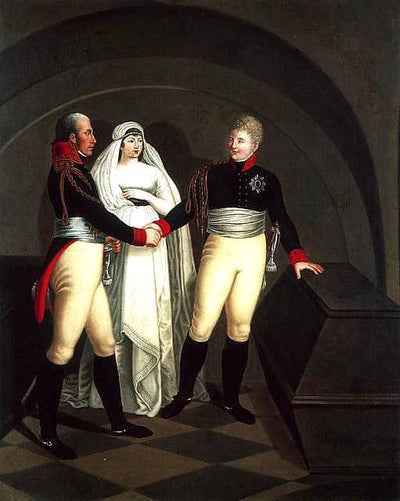
The year 1805 marked a pivotal moment in European history, as Czar Alexander I of Russia paid homage to the legendary Prussian leader, Frederick the Great. This ceremony took place in the context of shifting alliances and the rise of nationalism in Europe. The event symbolized not only respect for Frederick's military genius but also the intricate web of diplomacy that characterized the era.
Czar Alexander I emerged as a key figure in European politics during the early 19th century. His reign was marked by a desire to balance power among nations, especially against the backdrop of Napoleon's expansion. Alexander's tribute to Frederick the Great showcased his commitment to honoring historical leaders who shaped the continent's destiny.
Frederick the Great, who ruled from 1740 to 1786, left an indelible mark on Prussia and European history. Known for his military prowess and enlightened policies, he transformed Prussia into a major European power. His legacy included reforms in education, culture, and governance, which influenced future leaders and set the stage for modern Germany.
In Catel's painting, the portrayal of Frederick the Great's mortal remains serves as a poignant reminder of mortality and the transient nature of power. The somber atmosphere invites viewers to reflect on the weight of legacy and the respect afforded to those who shaped history. This theme resonates deeply, emphasizing the reverence for great leaders even after their passing.
The presence of King Frederick William III and Queen Louisa adds a layer of royal gravitas to the scene. Their participation signifies the continuity of Frederick the Great's legacy within the Prussian monarchy. Queen Louisa, known for her intelligence and compassion, played a crucial role in shaping public perception of the royal family during turbulent times.
Franz Ludwig Catel employed masterful oil painting techniques to convey emotion and detail in this historical scene. His ability to capture the nuances of human expression and the richness of textures brings the moment to life, allowing viewers to connect with the historical significance of the event.
Catel's color palette features a harmonious blend of warm and cool tones, creating a dynamic visual experience. The warm hues evoke a sense of reverence and nostalgia, while the cooler tones provide a contrast that highlights the solemnity of the occasion. This thoughtful use of color enhances the emotional depth of the painting.
The artist's brushwork is both precise and expressive, skillfully rendering the intricate details of the figures and their surroundings. Catel's technique allows for a vivid portrayal of fabric textures, facial expressions, and the overall atmosphere, making the painting a captivating visual narrative.
The composition of the painting is carefully arranged to convey hierarchy and importance. Czar Alexander I takes center stage, flanked by the royal couple, emphasizing his role as a leader paying tribute. This arrangement guides the viewer's eye and underscores the significance of each figure in the historical context.
Catel's use of light and shadow adds depth and drama to the scene. The interplay of light highlights the figures, drawing attention to their expressions and gestures. This technique not only enhances the three-dimensionality of the painting but also evokes a sense of solemnity and reverence.
This painting serves as a powerful reflection on leadership and legacy. It invites viewers to consider the qualities that define great leaders and the impact they leave on history. The tribute to Frederick the Great resonates with contemporary discussions about power, responsibility, and the role of leaders in society.
Catel's artwork continues to influence modern perceptions of power and leadership. By immortalizing a moment of respect and reflection, the painting encourages viewers to think critically about the qualities that make a leader truly great. It serves as a reminder that history shapes our understanding of authority and governance.
As a historical document, this painting captures a significant moment in time, preserving the emotions and sentiments of the era. It provides insight into the relationships between leaders and the cultural values of the early 19th century. Art becomes a lens through which we can explore the complexities of history.
Upon its unveiling, Catel's painting received mixed reactions from art critics and historians. Some praised its emotional depth and historical accuracy, while others questioned its idealization of leadership. Over time, however, it has gained recognition as a significant work that encapsulates the spirit of its time.
The painting has influenced subsequent artists and movements, inspiring those who explore themes of leadership and historical narrative. Its blend of realism and symbolism has left a lasting impact on the genre of historical painting, encouraging artists to engage with the past in meaningful ways.
Czar Alexander I stands as a visionary leader in the painting, embodying the ideals of diplomacy and respect. His role in the ceremony reflects his commitment to honoring the past while navigating the complexities of European politics.
King Frederick William III's presence underscores the continuity of Prussian leadership. His participation in the tribute highlights the importance of royal lineage and the responsibilities that come with power.
Queen Louisa's role in the ceremony illustrates the significant influence of royal women in shaping history. Known for her grace and intellect, she represents the often-overlooked contributions of women in the political sphere.
The crown and scepter depicted in the painting symbolize authority and governance. Their presence reinforces the themes of power and legacy, reminding viewers of the responsibilities that come with leadership.
The relics of Frederick the Great serve as a tangible connection to history. They represent the enduring impact of his reign and the respect he commands even in death. This aspect of the painting invites viewers to consider the lasting significance of historical figures.
The painting captures the 1805 ceremony where Czar Alexander I pays tribute to Frederick the Great, reflecting the political dynamics of early 19th-century Europe.
The key figures include Czar Alexander I, King Frederick William III, and Queen Louisa, each representing significant aspects of leadership and legacy.
Catel used oil painting techniques, employing a rich color palette and expressive brushwork to convey emotion and detail.
The painting influences modern perceptions of leadership and power, encouraging critical reflection on the qualities that define great leaders.
The main themes include mortality, legacy, and the reverence for historical figures, as well as the dynamics of power in leadership.
To ensure the reproduction captures the original's essence, choose a high-quality oil painting reproduction that emphasizes detail and color accuracy.
When displaying the reproduction, consider lighting, framing, and placement to enhance its visual impact and honor the historical significance of the artwork.

Discover some of our latest oil paintings, each one carefully hand-painted on canvas.
At Art & See, we're committed to delivering the highest quality art reproductions. Our team of expert artists and state-of-the-art processes ensure that each piece is a masterpiece in its own right.

Experience your masterpiece's creation through daily photos from our expert artists, each with 15+ years of experience.

Your artwork travels first class via UPS, FedEx, or DHL, protected by museum-grade packaging for safe delivery.

Review unedited photos of your finished painting and request unlimited free revisions before it ships. We only ship when you say it's perfect.

Every piece is crafted with archival materials, UV-resistant finishes, and premium British paints to last generations.




Yes, 100% hand-painted with oil on canvas by artists with 15+ years of experience. No prints, no digital shortcuts. You'll see and feel real brushstrokes, just like the original Franz Ludwig Catel masterpiece.
Your Czar Alexander I venerates the mortal remains of Frederick the Great in presence of King Frederick William III and Queen Louisa in 1805 reproduction takes 2–5 weeks to hand-paint depending on size and detail. Once approved, shipping takes 5–8 days via FedEx, UPS, or DHL with full tracking. Free worldwide shipping included.
Absolutely. Once your Czar Alexander I venerates the mortal remains of Frederick the Great in presence of King Frederick William III and Queen Louisa in 1805 is complete, we send you unedited photos, a full view and close-up details. Request unlimited free revisions until you're 100% satisfied. We don't ship until you say "yes."
Every painting goes through our Preview & Approve process: you receive unedited photos of your finished Franz Ludwig Catel reproduction and can request unlimited free revisions before it ships. We only ship when you say it's perfect. If after delivery you have any concerns, contact us at [email protected] and our team will work with you on the best path forward.
Professional-grade oil paints (Windsor & Newton) on premium linen canvas with UV-resistant protective coating. Museum-grade materials built to last generations, the same quality used in galleries worldwide.
Our artists specialize in Franz Ludwig Catel's technique: color accuracy, brushwork, and composition are matched to the original. Every reproduction goes through quality review before your approval photos are taken.
Every painting is insured and delivered door-to-door. Unframed paintings ship in protective hard tubes. Framed paintings are bubble-wrapped in sturdy boxes. If anything arrives damaged, we repair or replace it free.
Dive into the vibrant world of Historic Art. Discover your next painting today.