4.9/5
4.9/5


War Paintings
War paintings are the oldest public art in Europe, and this collection currently holds just 3 hand-painted oil reproductions: Battle of Eylau, February 9, 1807 by Antoine-Jean Gros, The Battle of La Hogue, Destruction of the French fleet, May 22, 1692 by Benjamin West and Battle scene by Michele Cammarano. The wider store carries many more military and history subjects, including Washington Crossing the Delaware by Emanuel Leutze, The Third of May 1808 by Francisco Goya, Liberty Leading the People by Eugene Delacroix, The Raft of the Medusa by Theodore Gericault and Oath of the Horatii by Jacques-Louis David. Every piece is hand-painted in oil on canvas by studio artists, never printed.
-
The Battle of La Hogue, Destruction of the French fleet, May 22, 1692


 Vendor:Benjamin West
The Battle of La Hogue, Destruction of the French fleet, May 22, 1692
- Regular price
- From $299.95
- Sale price
- From $299.95
- Regular price
-
$350.95
-
Battle of Eylau, February 9, 1807


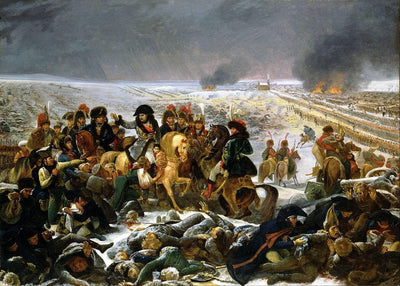 Vendor:Antoine-Jean Gros
Battle of Eylau, February 9, 1807
- Regular price
- From $299.95
- Sale price
- From $299.95
- Regular price
-
$350.95


Frequently Asked Questions
How much do Battle oil painting reproductions cost?
Our Battle oil painting reproductions start at $299.95. Prices vary by size: larger canvases and custom dimensions cost more. Every painting includes free worldwide shipping and a 90-day satisfaction guarantee.
What Battle paintings are available?
We carry 2+ Battle oil painting reproductions. Highlights include The Battle of La Hogue, Destruction of the French fleet, May 22, 1692, Battle of Eylau, February 9, 1807. Every piece is hand-painted by professional artists on premium canvas.
Are these Battle prints or hand-painted reproductions?
Every Battle reproduction is 100% hand-painted by professional artists using premium oil paints on gallery-grade canvas. These are not prints, giclées, or digital reproductions. Each piece captures the original brushwork, texture, and color depth of the masterpiece.
What sizes are available for Battle painting reproductions?
Each Battle painting is available in multiple standard sizes, from small (16" × 20") to large museum-scale formats. Custom dimensions are available upon request. Contact us with your preferred size for a quote.
How long does it take to receive my painting?
Each painting is made to order. Production takes 2–3 weeks, plus 5–10 business days for worldwide shipping. Total delivery time is typically 3–5 weeks depending on your location. Shipping is free worldwide.
What is your return policy?
We offer a 90-day satisfaction guarantee. If you're not completely happy with your painting, contact us for a full refund or replacement, no questions asked.
What a war painting is
History painting is a genre defined by its subject matter rather than by any artistic style or specific period. Pictures of that kind depict a moment in a narrative story, most often Greek and Roman mythology and Bible stories, as opposed to a specific and static subject such as a portrait, a still life or a landscape. The term is derived from the wider senses of the word historia in Latin and histoire in French, meaning story or narrative, and essentially means story painting. Most of them are not scenes from the past at all, especially those from before about 1850.
A war painting is the branch of that genre where the story is a battle, a siege, an execution or an aftermath on the battlefield. It was the most prestigious thing a painter could make for most of four centuries, because it was the largest, the most difficult and the most public. It was also, more often than not, propaganda paid for by the winner.
Understanding that is the key to the whole subject. A battle picture is rarely a report. It is a claim about who was brave, who was right and who should be remembered, made by artists who were usually not present.
The three works in this collection
- Battle of Eylau, February 9, 1807 by Antoine-Jean Gros, a French Napoleonic subject named for its date.
- The Battle of La Hogue, Destruction of the French fleet, May 22, 1692 by Benjamin West, a naval action from the end of the seventeenth century. West is the British and American painter whose history subjects set the pattern for a century of military art on both sides of the Atlantic.
- Battle scene by Michele Cammarano, an Italian nineteenth century picture with no named engagement in the title.
Three works is a small group for a subject this large, and the reason is technical rather than editorial: the rule that fills this page is narrower than the material in the catalog. There are many more war and battle subjects in the store than appear here, and the section below points to them.
Famous war paintings in the wider store
These are the pictures people search for when they search for this subject, and all of them can be ordered as hand-painted reproductions in oil.
- The Third of May 1808 by Francisco Goya, completed in 1814. In the work Goya sought to commemorate Spanish resistance to Napoleon's armies during the occupation of Madrid in 1808, at the start of the Peninsular War. Along with its companion piece of the same size, The Second of May 1808, it was commissioned by the provisional government of Spain at Goya's own suggestion, shortly after the ousting of the French occupation and the restoration of King Ferdinand VII. Goya is often called the last of the Old Masters and the first of the moderns.
- Washington Crossing the Delaware by Emanuel Leutze, the title of three 1851 oil-on-canvas paintings by the German-American artist depicting General George Washington's crossing of the Delaware River with the Continental Army on the night of December 25 to 26, 1776, during the American Revolutionary War. That covert crossing was the first of several moves leading to a surprise attack and victory against Hessian forces at the Battle of Trenton in New Jersey on the following morning.
- Liberty Leading the People by Eugene Delacroix, a painting of the Romantic era commemorating the July Revolution of 1830 that toppled King Charles X. A woman of the people in a Phrygian cap, personifying Liberty, leads a group forward over a barricade and the bodies of the fallen, holding the tricolour in one hand and a bayonetted musket in the other, accompanied by a young boy with a pistol in each hand. The figure is also read as Marianne, a symbol of France and the French Republic, and the picture is sometimes wrongly thought to depict the French Revolution of 1789.
- The Raft of the Medusa by Theodore Gericault, originally titled Scene de Naufrage, an oil of 1818 and 1819 completed when he was 27. At 491 by 716 cm it is an over life-size work depicting a moment from the aftermath of the wreck of the French naval frigate Meduse, which ran aground off the coast of today's Mauritania on 2 July 1816. On 5 July at least 150 people were set adrift on a hurriedly constructed raft; all but 15 died in the 13 days before rescue. The event became an international scandal, in part because its cause was widely attributed to the incompetence of the French captain.
- Oath of the Horatii by Jacques-Louis David, a large canvas made in 1784 and 1785 and now on display in the Louvre in Paris. It became a huge success with critics and the public immediately and remains one of the best-known works in the Neoclassical style.
- The Fighting Temeraire by Joseph Mallord William Turner, made in 1838 and exhibited at the Royal Academy in 1839: a warship that fought at Trafalgar, under tow to the breakers.
- Officer of the Chasseurs Charging on Horseback, also known as the Charging Hussar, by the same hand.
- St. George and the Dragon by Paolo Uccello and The Return of the Crusader by Karl Lessing, two pictures of combat as legend rather than as record.
- Rainy Day in Camp, also known as Camp near Yorktown, by Winslow Homer, an American camp of soldiers rather than an engagement.
- Study to The Conquest of Siberia by Yermak by Vasily Surikov and Sinking the Turkish steamer Intibach by Lev Lagorio, two Russian subjects.
- Fight of the Poursuivante Against the British Ship Hercules, 28 June 1803 by Louis-Philippe Crepin and Submarine Torpedo Boat H.L. Hunley, Dec. 6, 1863 by Conrad Wise Chapman.
- Die Hunnenschlacht by Wilhelm von Kaulbach and The Battle of Dogali by Michele Cammarano.
Artists who made the genre
A short list of the artists worth knowing here, with what the record supports. New buyers usually start with one of these names, and a national gallery anywhere in Europe will have several of them.
Francisco Goya was a Spanish romantic painter and printmaker, considered the most important Spanish artist of the late 18th and early 19th centuries. His canvases, drawings and engravings reflected contemporary historical upheavals and influenced important 19th and 20th century painters, and he is widely regarded as one of the most influential figures Western art has produced.
Eugene Delacroix was a French Romantic artist regarded as the leader of the French Romantic school, and Liberty Leading the People is the picture that put a political event into the language of grand painting.
Theodore Gericault, 1791 to 1824, was a French Romantic painter and lithographer. He chose a large-scale uncommissioned work to launch his career, using a subject that had already generated widespread public interest, and that decision changed what a young painter could attempt.
Jacques-Louis David is the Neoclassical master, and the Oath of the Horatii is one of the best-known works in that style. It is now on display in the Louvre in Paris.
Benjamin West is the painter whose story subjects travelled between Britain and America and set the terms for what a heroic modern scene should look like.
Ilya Repin, the Russian realist, made Ivan the Terrible and His Son Ivan between 1883 and 1885. It shows the grief-stricken tsar cradling his dying son shortly after he had dealt the fatal blow in a fit of anger, and it is the clearest example in art of the genre turning against its own tradition of glory.
Camps, sieges and the parts of war that are not battles
Not every war picture is an attack on a hill. A large part of the tradition covers the rest of it: the camp, the march, the waiting, the battlefield afterwards. Winslow Homer's Rainy Day in Camp, also known as Camp near Yorktown, is exactly that, and works like it are often more interesting than the engagements because nothing is being staged.
The aftermath is the other rich vein. A field the morning after, a surrender, a field hospital, a raft of survivors. Gericault's Medusa is the most famous, and it is worth noting that it is not a battle at all: it is a shipwreck caused by incompetence, and the picture became an international scandal for that reason.
If you want a war subject without the fighting, look for a camp, a portrait of an officer, a ship at anchor, or a legendary combat like St. George and the dragon. These carry the same period, the same uniforms and the same painterly qualities, and they are a great deal easier to hang in a room where people eat.
A note on the rule behind this page
This collection is smaller than the material in the store justifies. The store holds many more war and battle subjects than the three listed at the top, distributed across the story, horse, seascape and mythology groups, and the links above reach a representative set of them. If you arrived expecting a large military section, use those links rather than the grid. A new rule would widen the page considerably.
The store carries reproductions of work that is out of copyright, which for this subject means everything up to the early twentieth century. The great war art of the last hundred years is not available here and will not be. What is here instead is the long tradition that produced it: Napoleonic France, the Peninsular War, the American Revolutionary War and its regiments, the naval age, and the Russian and Italian nineteenth century.
Regiments, navies and who paid for these pictures
It helps to know who the client was, because it shaped everything. A regiment commissioned pictures of its own actions and hung them in its mess. A navy commissioned fleet actions. A city commissioned its own siege. A government commissioned the founding moment of a state, which is what the Leutze subject is: three 1851 canvases of General George Washington crossing the Delaware River with the Continental Army during the American Revolutionary War.
Private buyers came later, and they bought engravings rather than canvases. A successful battle picture was reproduced as a print and sold in thousands, and for most of the 19th century that print was how the public knew the image. Many of the pictures on this page were famous as prints long before anyone saw the original in a museum or a national gallery.
That history has a consequence worth knowing. Because these works were made for public rooms, they are built to be read at a distance and in poor light, which is exactly why they still work on a large wall today and exactly why they fail at small sizes.
Land, sea and the two kinds of picture
War subjects split cleanly into two families, and they behave completely differently on a wall.
The land battle is a crowd. Troops, smoke, horses, an army arranged across a wide field, and usually one figure, a general or an emperor, placed where the light falls, with the troops of an entire army behind him. Gros's Eylau is that kind, and so is the Cammarano. The dead and the wounded are usually in the foreground on the left. These pictures need width and distance: they are built to be read from a few meters back, and at close range they become a puzzle of limbs and uniforms.
The naval action is the opposite. A sea fight is a small number of very large objects in an enormous space, which gives the picture a clear shape and a horizon. Benjamin West's La Hogue, Crepin's Poursuivante and Lagorio's Batumi raid all belong here, and naval subjects hang more easily in a house than land battles do. They are also, oddly, the calmer of the two kinds, because water imposes order on everything floating in it.
Dates in the title, and why they are there
Look at the titles on this page: February 9, 1807. May 22, 1692. June 28, 1803. The sixth of December, 1863. Almost every serious battle picture carries a date, and often a day and a month.
That is not decoration. A battle picture was a public record, made for a government, a navy, a regiment or a city, and the date was the point: this happened, and here is what it looked like. The Leutze subject is dated to the night of December 25, 1776. Goya named his for the third of May. The Raft of the Medusa turns on the wreck of 2 July 1816 and the rescue thirteen days later.
When you buy one of these, you are buying a specific claim about a specific date. It is worth reading the title carefully, since the date usually tells you which side commissioned the work. A national museum will often hold both versions of the same event, painted from opposite ends of it.
Heroes, victims and the change in the nineteenth century
The subject changes character around 1800, and the change is the most interesting thing about it.
Before that, a battle picture is about victory and command. A general on a hill, a surrender being accepted, a fleet in flames, the death of a general at the moment of triumph. Benjamin West and William Hogarth belong to the generation that made that formula and exported it across Britain and America, and it is why an eighteenth century war picture looks like theater.
After that, the victims arrive. Goya's Third of May 1808 shows an execution, not a battle, and the man about to be shot is a nobody, one of the soldiers' many victims. Gericault paints the survivors of a wreck caused by incompetence. Delacroix paints a revolution over the bodies of the fallen. Repin, later in the century, paints a tsar who has just killed his own son and knows it. The prestige of the genre stayed, and the message inverted.
That shift is why the later war pictures are the ones most people want to live with. They are about the cost rather than about the win, and they have aged in a way the triumphal ones have not.
Choosing a battle subject for a room
Three practical points. Size first: these were built big, often for a public building, and they need the middle or upper sizes to make sense. A crowd of troops at the smallest size turns into texture.
Then the ground. Most of them are dark: smoke, mud, night, a low horizon. They want a warm lamp and a wall that is not white, and they overwhelm a small pale room. The naval subjects are the exception and take daylight well.
Then the content. Be honest with yourself about the wounded and the dead. Some of the most famous pictures in this genre contain a great deal of both, and a picture you admire in a museum is not always one you want to see at breakfast. If that matters, choose a naval action, a camp scene or a legendary combat like St. George rather than an execution or a field after a battle.
How each reproduction is made
One studio hand works from the museum reference in oil, building the ground and the smoke first and the figures last, which is the order they were originally built. Nothing is printed and nothing is transferred at any stage. Seven sizes are available with an optional frame, and you approve a photo of the finished work before it ships. Free worldwide shipping and 90-day returns apply. On a crowded subject like this one, ask for a detail of the central group in the approval photo, since that is where the whole composition holds together or does not.
Browse related collections
War subjects sit inside the story and horse groups.
- Myth, legend and the classical past for combat as story.
- Horses under a rider for the cavalry subject.
- Ships in action for naval engagements.
- The Romantic century for Gros, Gericault and Delacroix.
- Neoclassical works for David and the generation before them.
Frequently asked questions
What is a history painting? A genre defined by its subject matter rather than by style or period, in which the picture depicts a moment in a narrative story, most often from Greek and Roman mythology or the Bible, as opposed to a static subject like a portrait or a landscape. The term comes from historia in Latin and histoire in French, meaning story, so it essentially means story painting.
Were these artists present at the battles they show? Almost never. Most war subjects were made years after the event, from accounts, sketches and imagination, and museum labels rarely say so, and commissioned by a government or a patron with a view about what happened. The dates in the titles record the engagement, not the day the work was finished.
Are these prints? No. Each is an original oil on canvas, made by hand in the studio, in seven sizes, with an optional frame and a photo of the finished work for your approval before it ships.
We’ll Paint Any Image You Want
Just send us a photo or the painting name and our artists will hand-paint it for you.