4.9/5
4.9/5






SAMPLES OF QUALITY
Recent Hand-Painted Reproductions
Discover some of our latest oil paintings, each one carefully hand-painted on canvas.

AS SEEN IN





Handmade Oil Painting on Canvas Art Reproduction, Museum-quality

The six dominant colors measured from the painting, with the share of canvas each one covers. Click a swatch to copy its hex code.
Processing & Shipping Time
Your delivery time includes two parts:
Shipping Methods
We ship with trusted couriers like FedEx, UPS, and DHL. Every shipment includes a tracking code.
Our goal is to deliver your order safely and quickly.
Shipment Safety Measures
We handle your products with care so they arrive in perfect condition:
Every product is insured and delivered right to your door, so you can feel confident buying from us.
Every Art & See painting is created by artists with 15+ years of experience using professional-grade oil paints and premium linen canvas with UV-resistant protective coating, the same museum-grade materials used in galleries worldwide. Each piece goes through quality review before your approval photos are taken. If after delivery you have any concerns about your painting, contact us at [email protected] and our team will work with you on the best path forward.
Full Warranty
Every painting is protected against physical damage during shipping. If your painting arrives damaged, we repair or replace it, free of charge.
Coverage Details
Transit damage (crushed, torn, water damage): we repair or replace at no cost. Please note that damages resulting from accidents or inappropriate use are not covered under this warranty.
Repair or Replace
Depending on the extent of damage, the affected painting will either be repaired or replaced at no additional cost to you.
Free Service
All warranty services are provided absolutely free of charge.
We want you to absolutely love your handmade artwork. Here's how it works:
In the rare case you approve the photos and the artwork has been shipped and delivered to you, and you still want additional modification requests, we can handle it as a courtesy at our discretion. If accepted, you cover the return shipping cost.
| Type | Hand-Painted Oil Painting Reproduction |
| Original Artist | Jacopo Pontormo |
| Price Range | $350 to $1,150 |
| Shipping | Free Worldwide |
| Quality | Preview & Approve Before Shipping |
| Medium | Oil on Canvas |
| Canvas | Museum-Grade Linen Canvas |
| Technique | Hand-painted brushstroke-by-brushstroke |
| Art Style | Mannerism Late Renaissance |
| Period | 17th Century |
| Artist Nationality | Italian |
| Orientation | Vertical |
| Subject | Cultural heritage, Cultural heritage mythology, Cultural heritage religious, Fantasy, Portraits group, Religion |
| Available Sizes | 7 (16'' W × 19'' H to 54'' W × 65'' H, including the original size), plus custom sizes |
| Framing Options | Unframed, Stretched Canvas, Classic & Modern Frames |
| Delivery | 14–28 business days |
| Size | 60 × 72 cm (23.5 × 28.5 in) |
| Year | 1522 |
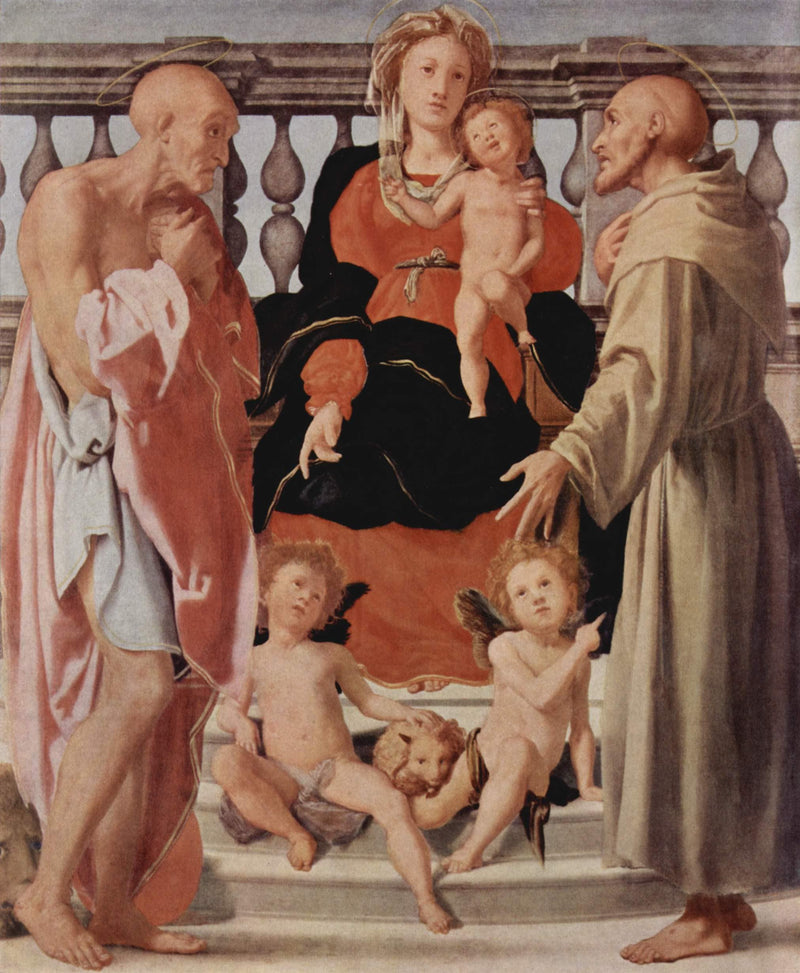
Jacopo Pontormo created 'Madonna with St. Francis and St. Jerome' during the Florentine Renaissance, a period marked by a revival of classical learning and artistic innovation. This era, flourishing in the 15th and 16th centuries, saw artists like Michelangelo and Leonardo da Vinci redefine art. Florence became a hub of creativity, where humanism influenced not just art but also philosophy and science.
Pontormo, born in 1494, was deeply influenced by this cultural rebirth. His work reflects the vibrant spirit of Florence, showcasing a blend of traditional religious themes with a fresh, emotional approach. This painting, completed around 1525, stands as a testament to the rich artistic heritage of the time.
Pontormo is often associated with Mannerism, a style characterized by elongated forms and exaggerated poses. Unlike the balanced compositions of the High Renaissance, Mannerism embraced complexity and emotional depth. In 'Madonna with St. Francis and St. Jerome,' Pontormo's figures exhibit a sense of movement and tension, inviting viewers to engage with their emotional states.
This painting also reflects Pontormo's innovative use of color and light, which enhances the emotional impact of the scene. His ability to convey feelings through art sets him apart from his contemporaries, making his work a significant contribution to the evolution of Western art.
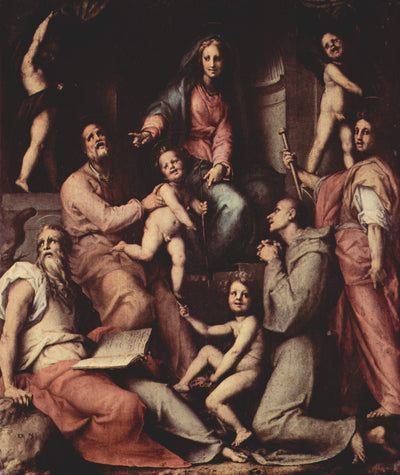
The central figure, the Madonna, embodies motherhood and divine grace. She cradles the Christ Child, symbolizing protection and nurturing. St. Francis, known for his love of nature and animals, represents humility and compassion. His presence emphasizes the connection between the divine and the natural world.
St. Jerome, the scholar and translator of the Bible, adds a layer of intellectual depth to the painting. His gaze and posture suggest contemplation, inviting viewers to reflect on the spiritual and scholarly pursuits of the time.
Pontormo's color palette features soft pastel hues, creating a serene yet emotionally charged atmosphere. The delicate pinks, blues, and greens contrast with the dramatic shadows, enhancing the three-dimensionality of the figures. This interplay of light and color draws the viewer's eye and evokes a sense of tranquility.
The use of color not only serves an aesthetic purpose but also reinforces the emotional themes of the painting. The gentle tones reflect the tenderness of the Madonna's love, while the shadows add depth and complexity to the characters' expressions.
Pontormo employs a triangular composition, a hallmark of Renaissance art, to create balance and harmony. The arrangement of the figures forms a stable triangle, guiding the viewer's gaze toward the Madonna and Child at the apex. This structure symbolizes the Holy Trinity and emphasizes the divine nature of the scene.
The spatial arrangement also enhances the interaction between the figures. St. Francis and St. Jerome lean toward the Madonna, creating a sense of unity and shared purpose. This dynamic composition invites viewers to contemplate the relationships between the sacred and the earthly.
In 'Madonna with St. Francis and St. Jerome,' the Madonna represents the ideal of motherhood. Her protective embrace of the Christ Child signifies divine love and care. This theme resonates deeply within Christian theology, highlighting the importance of maternal figures in spiritual life.
The painting invites viewers to reflect on the role of women in religious contexts, emphasizing the nurturing aspect of faith. The Madonna's serene expression conveys a sense of peace, reinforcing her role as a protector and guide.
St. Francis is celebrated as the patron saint of animals and the environment. His presence in the painting underscores the connection between spirituality and nature. Pontormo captures St. Francis's humility and compassion, inviting viewers to appreciate the beauty of creation.
This theme of environmental stewardship is particularly relevant today, as it encourages a deeper understanding of our relationship with the natural world. St. Francis's legacy continues to inspire movements focused on ecological awareness and conservation.
St. Jerome's role as a scholar adds an intellectual dimension to the painting. He is known for translating the Bible into Latin, making the scriptures accessible to a broader audience. His presence in the artwork highlights the importance of knowledge and education in the Christian faith.
Pontormo's portrayal of St. Jerome encourages viewers to engage with biblical texts and explore their meanings. This emphasis on scholarship reflects the Renaissance's value on learning and the pursuit of truth.
Pontormo's mastery of oil painting techniques is evident in 'Madonna with St. Francis and St. Jerome.' He employed layering and glazing to create depth and luminosity. This method allows for rich color variations and a sense of three-dimensionality.
The careful application of paint enhances the textures of the figures' clothing and the softness of the Madonna's skin. This attention to detail showcases Pontormo's skill and dedication to his craft.
Pontormo's expressive brushwork captures the emotional intensity of the scene. His dynamic strokes convey movement and energy, bringing the figures to life. This technique allows viewers to feel the emotions of the characters, creating a powerful connection to the artwork.
The fluidity of the brushwork also reflects the Mannerist style, emphasizing the emotional over the rational. This approach invites viewers to experience the painting on a deeper, more personal level.
Pontormo's 'Madonna with St. Francis and St. Jerome' significantly influenced the Mannerist movement and later artists. His innovative use of color, composition, and emotional expression set a new standard for artistic exploration. Artists like El Greco and Parmigianino drew inspiration from Pontormo's work, incorporating similar techniques into their own styles.
This legacy continues to resonate in contemporary art, where emotional expression and unique perspectives remain vital. Pontormo's ability to convey complex themes through visual art has left an indelible mark on the art world.
When comparing 'Madonna with St. Francis and St. Jerome' to other Renaissance masterpieces, similarities in themes and techniques emerge. Like Raphael's 'Madonna of the Pinks,' Pontormo's work emphasizes the maternal bond and divine protection. Both artists utilize color and composition to evoke emotion and convey spiritual messages.
Additionally, the influence of Michelangelo's sculptural forms can be seen in Pontormo's figures. The dynamic poses and emotional expressions reflect a shared commitment to exploring the human experience through art.
You can experience the original 'Madonna with St. Francis and St. Jerome' at the Museum of San Lorenzo in Florence, Italy. This museum houses a rich collection of Renaissance art, making it a must-visit for art enthusiasts. The museum's central location in Florence makes it easily accessible for tourists and locals alike.
Visitors can immerse themselves in the beauty of Pontormo's work while exploring the historical context of the Renaissance. The museum offers guided tours that provide deeper insights into the artwork and its significance.
In addition to Pontormo's masterpiece, the Museum of San Lorenzo features works by other prominent Renaissance artists. Visitors can explore pieces by Michelangelo, Donatello, and Botticelli, providing a comprehensive view of the artistic achievements of the time. Special exhibitions often highlight the connections between these artists, enhancing the overall experience.
The museum also hosts educational programs and workshops, allowing visitors to engage with art on a personal level. This interactive approach fosters a deeper appreciation for the artistic legacy of the Renaissance.
The figures of the Madonna, St. Francis, and St. Jerome represent key themes of motherhood, compassion, and scholarship in Christian theology. Their interactions convey a message of divine love and the importance of knowledge.
Pontormo's Mannerist style is characterized by emotional expression, elongated forms, and dynamic compositions. This contrasts with the balanced and harmonious approach of High Renaissance artists like Raphael and Leonardo da Vinci.
The painting explores themes of motherhood, divine protection, humility, and the pursuit of knowledge. These themes resonate deeply within the context of Renaissance humanism and Christian spirituality.
Pontormo used oil painting techniques such as layering and glazing to create depth and luminosity. His expressive brushwork adds texture and emotional intensity to the figures.
You can see the original 'Madonna with St. Francis and St. Jerome' at the Museum of San Lorenzo in Florence, Italy. This museum offers a rich collection of Renaissance art, making it a prime destination for art lovers.
When purchasing a reproduction of 'Madonna with St. Francis and St. Jerome,' consider the quality of the materials used. Look for reproductions that use high-quality canvas and oil paints to capture the original's details and colors accurately.
Choose a reputable art reproduction company that specializes in oil painting reproductions. They should provide samples of their work and guarantee that their reproductions reflect the original's textures, colors, and emotional depth.

Discover some of our latest oil paintings, each one carefully hand-painted on canvas.
At Art & See, we're committed to delivering the highest quality art reproductions. Our team of expert artists and state-of-the-art processes ensure that each piece is a masterpiece in its own right.

Experience your masterpiece's creation through daily photos from our expert artists, each with 15+ years of experience.

Your artwork travels first class via UPS, FedEx, or DHL, protected by museum-grade packaging for safe delivery.

Review unedited photos of your finished painting and request unlimited free revisions before it ships. We only ship when you say it's perfect.

Every piece is crafted with archival materials, UV-resistant finishes, and premium British paints to last generations.
Yes, 100% hand-painted with oil on canvas by artists with 15+ years of experience. No prints, no digital shortcuts. You'll see and feel real brushstrokes, just like the original Jacopo Pontormo masterpiece.
Your Madonna with St. Francis and St. Jerome reproduction takes 2–5 weeks to hand-paint depending on size and detail. Once approved, shipping takes 5–8 days via FedEx, UPS, or DHL with full tracking. Free worldwide shipping included.
Absolutely. Once your Madonna with St. Francis and St. Jerome is complete, we send you unedited photos, a full view and close-up details. Request unlimited free revisions until you're 100% satisfied. We don't ship until you say "yes."
Every painting goes through our Preview & Approve process: you receive unedited photos of your finished Jacopo Pontormo reproduction and can request unlimited free revisions before it ships. We only ship when you say it's perfect. If after delivery you have any concerns, contact us at [email protected] and our team will work with you on the best path forward.
Professional-grade oil paints (Windsor & Newton) on premium linen canvas with UV-resistant protective coating. Museum-grade materials built to last generations, the same quality used in galleries worldwide.
Our artists specialize in Jacopo Pontormo's technique: color accuracy, brushwork, and composition are matched to the original. Every reproduction goes through quality review before your approval photos are taken.
Every painting is insured and delivered door-to-door. Unframed paintings ship in protective hard tubes. Framed paintings are bubble-wrapped in sturdy boxes. If anything arrives damaged, we repair or replace it free.
Dive into the vibrant world of Historic Art. Discover your next painting today.